

Why Your AI-Generated Code Keeps Turning Into a Mess
Why Your AI-Generated Code Keeps Turning Into a Mess (the Pipeline That Actually Fixes It)
Written by Mukesh · Reviewed Aug 27, 2026
I've lost count of how many times I've pasted a feature request into an AI coding tool, watched it spit out 300 lines in ten seconds, and then spent the next hour untangling what it actually did. The speed is real. The mess is also real. And for a while I thought the fix was just "read the code more carefully before accepting it."
Turns out that's the wrong fix. You can't manually review thousands of lines of generated code fast enough to catch what matters — your eyes glaze over by line 150 no matter how disciplined you are. What changed my thinking was a conversation between Robert Martin (the "Uncle Bob" who wrote Clean Code) and Matt Pocock, where Martin made a point that stuck with me: the fix isn't more careful reading, it's building an automated pipeline that catches bad code before a human ever needs to look at it.
That idea is basically an assembly line for code quality — seven stages, each one a checkpoint, each one refusing to pass work forward until it meets a bar. I ended up sketching it out for my own use, and figured it's worth sharing since most of us are hitting this exact wall right now.
The core problem with "just review the AI's code"
When a model writes code fast, the bottleneck moves from writing to verifying. And verifying by eyeballing doesn't scale — not because reviewers are lazy, but because human attention just isn't built to catch a subtle bug buried inside code that looks correct at a glance. The fix has to be structural, not willpower-based. You need gates the code physically cannot pass through unless it satisfies a rule, the same way a CI pipeline blocks a merge on a failing test.
The seven-stage setup does exactly that, split into two halves: a build phase where requirements get locked down before any implementation happens, and a verification phase where that implementation gets stress-tested before it ships.
Phase one: pin down what "correct" means before writing any code
The first four stages exist to remove ambiguity, because ambiguity is where an AI model quietly invents its own assumptions about your business logic.
A spec agent turns a loose user story into formal given-when-then scenarios — essentially a finite state machine written in plain English. Once that's locked, a test-binding agent builds the acceptance test scaffolding, and a unit test agent writes the actual failing tests, covering edge cases and boundary values. Only after all of that exists does a coder agent get let loose to write implementation code — and its only job is making those pre-written tests pass. It's not allowed to touch or weaken any existing test, which closes off the laziest failure mode: an AI quietly rewriting a test so its broken code passes.
Here's how that first half looks laid out:
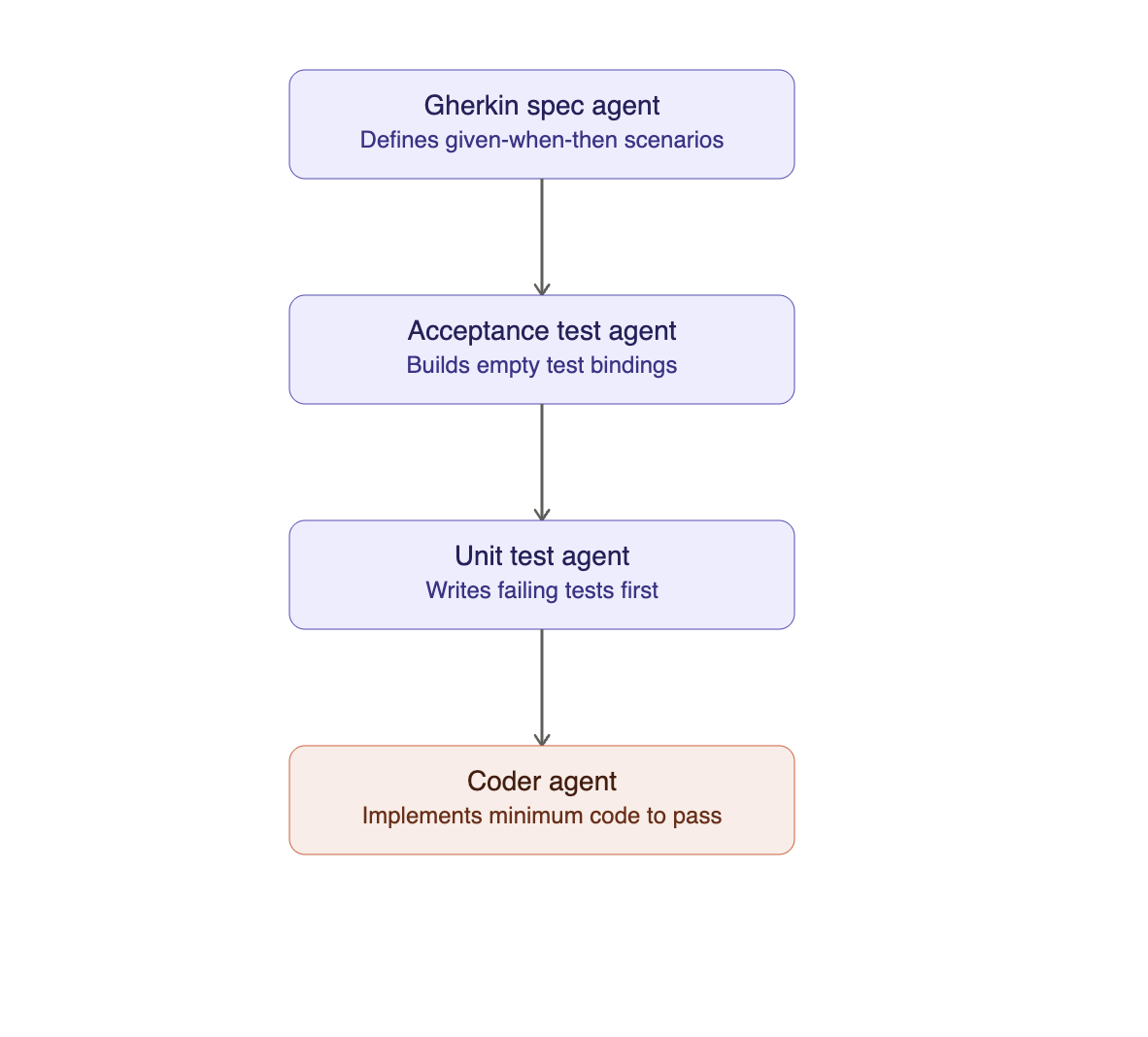
If this feels like old-school TDD, that's because it is. Writing tests before code isn't a new invention — what's new is doing it as a hard gate that an agent enforces, rather than a discipline a tired developer skips at 6pm on a Friday.
Phase two: prove the code is actually solid, not just passing
Getting tests to go green is the easy part. The harder question is whether those tests are actually strong enough to catch a real bug, or whether they'd happily pass broken code too.
A reviewer agent goes first, checking the implementation against basic clean-code rules — single responsibility, readable names, and a hard cap on cyclomatic complexity. Anything too tangled gets kicked back for restructuring instead of getting waved through.
Then comes the part I found genuinely clever: a mutation testing agent deliberately breaks the code on purpose. It flips a > to a >=, swaps true for false, deletes a line — small, targeted sabotage — and reruns the test suite. If the tests still pass after the code was broken, that "mutant" survived, which means the test suite has a blind spot. The agent keeps generating new tests until close to no mutants survive. Only after that does a final QA agent validate full user journeys end-to-end and clear the code for production.
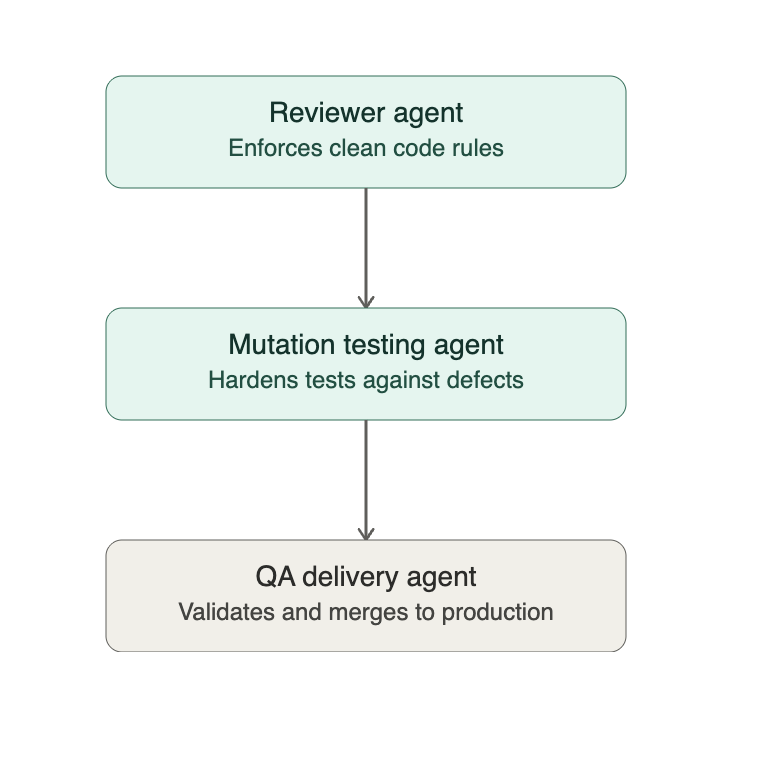
The two phases connect with feedback loops, not a straight line. If mutation testing finds a weak spot, it sends work back to the unit test agent to strengthen coverage — not straight to production. If the reviewer flags a complexity violation, it goes back to the coder agent for a rewrite, not a shrug and a merge.
A couple of things worth stealing even outside a full pipeline
Don't try to write one giant upfront spec. The old structured-analysis approach — writing an exhaustive spec before a line of code exists — sounds thorough, but in practice it either takes forever or produces a document too large for a model's context window to use well. A tighter loop works better: story, approach, test harness, verification, repeat on the next slice.
Give agents a map, not the whole codebase. Large systems get incomprehensible fast, for AI agents just as much as for people. A high-level architecture diagram that an agent can drill down from — module, then sub-component — lets it work with only the context it actually needs for the change at hand, instead of dragging the entire repo into every prompt.
Your job shifts from writing code to designing the harness. This is the actual mindset change. The valuable skill isn't typing fast anymore — it's deciding what "correct" means precisely enough that an automated pipeline can enforce it without you standing over its shoulder.
None of this means fundamentals stopped mattering because AI showed up. If anything, TDD, complexity limits, and mutation testing matter more now — they're the only thing standing between "AI wrote this in ten seconds" and "AI wrote garbage in ten seconds," and from the outside, both look identical until someone actually checks.
If you're already running any AI coding agent in your workflow, even wiring up two or three of these gates — starting tests, then a complexity check, then mutation testing — will catch more than an extra hour of manual review ever will.
About the author
Mukesh is the developer behind InfoMukesh, writing practical notes from hands-on work with PHP, Laravel, e-commerce platforms, AI, and web applications.